
A business can publish consistently for two years and still feel like it's starting from scratch every Monday.
The team has a content calendar, established workflows, perhaps even AI tools that make production faster. Yet every new article requires fresh research, every LinkedIn post begins with another search for ideas, and useful insights from previous work rarely make it into the next piece. The business is producing more content without necessarily becoming better equipped to grow.
To build a content system that compounds over time, you need to connect content strategy, reusable knowledge, valuable assets, distribution, and performance learning into one operating process. Each publishing cycle should strengthen something the business can use again, whether that's search visibility, audience trust, research, relationships, or a clearer path to conversion.
The important question is what your previous content work makes possible that wasn't possible before.
A content system compounds when its outputs become inputs for future growth
A content calendar tells you what to publish and when. A content workflow determines how ideas move through research, creation, editing, and publication. A content strategy establishes which audiences, problems, and business objectives deserve attention.
All three are useful. But none guarantees that the work will accumulate value.
A compounding content system connects those activities so that published content, accumulated knowledge, audience relationships, and performance insights improve future work.
Consider three businesses. The first publishes whenever someone has an idea. The second has an efficient production process and publishes every week. The third also publishes regularly, but its articles strengthen existing resources, its customer research informs future topics, its distribution develops recurring audiences, and its performance reviews change what gets built next.
The third business has created the conditions for compounding.
What actually accumulates?
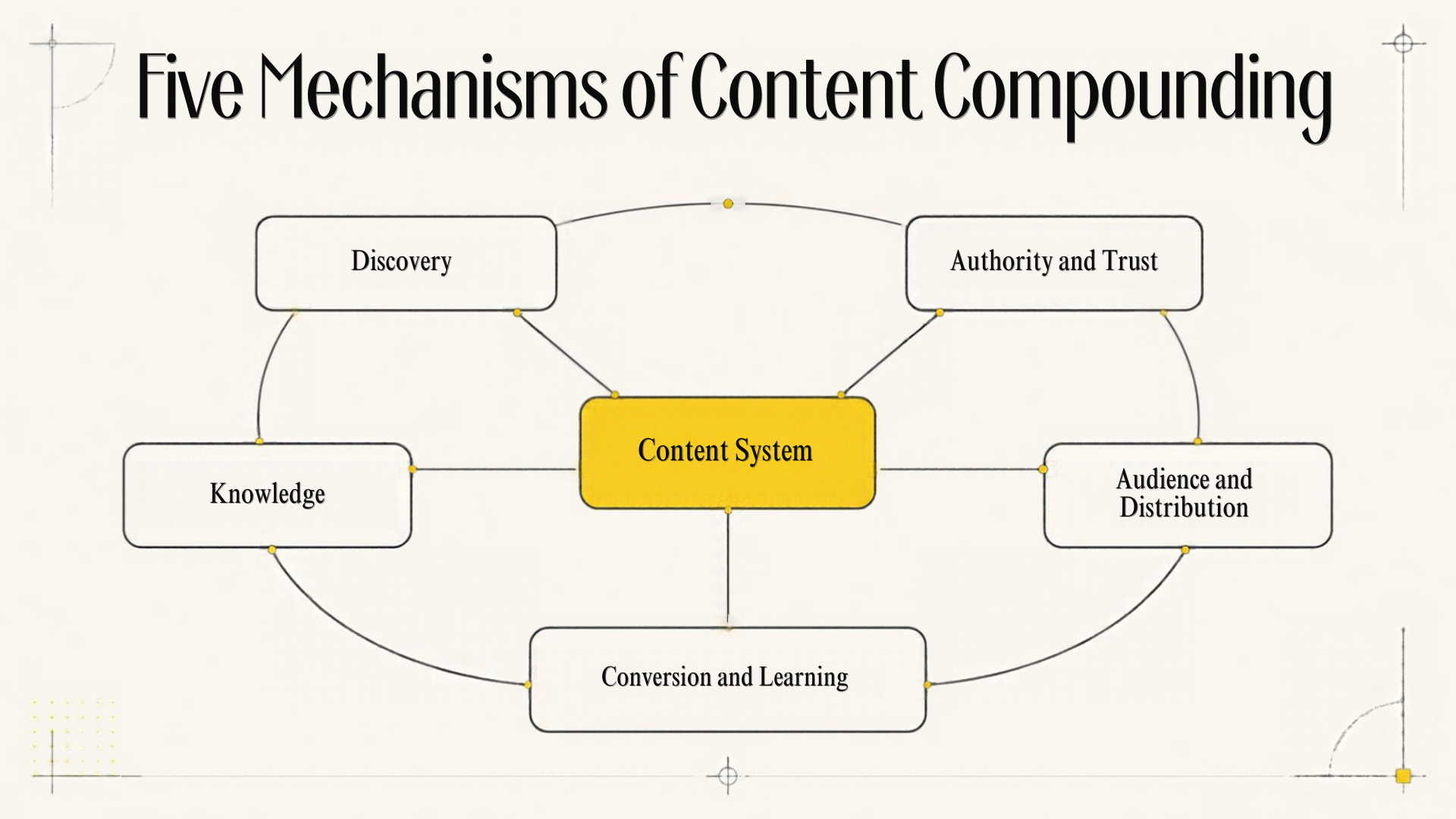
Discovery: Evergreen articles, useful landing pages, topic clusters, and searchable resources create additional opportunities for relevant people to find the business. An established article may continue attracting visitors while the team works on something else.
Authority and trust: Repeated demonstrations of expertise help audiences understand what a business knows and where it can help. A founder's observations, customer stories, original research, and detailed explanations can reinforce a recognizable position.
Knowledge: Research, customer questions, examples, and expert insights become reusable inputs. Future content benefits from work the organization has already completed.
Audience and distribution: Newsletter subscribers, professional relationships, communities, and recurring readers create opportunities to reach people without rebuilding every distribution effort from zero.
Conversion and learning: Content reveals what people care about, what attracts qualified interest, and which questions remain unresolved. Those signals can improve future resources, offers, and conversion paths.
These mechanisms become especially valuable when they reinforce one another.
An SEO article attracts relevant readers. Some explore a related checklist. Their questions reveal a problem the original article didn't address. The company develops a more specific resource, connects it to the existing article, and uses the new insight to improve its service page.
The business now has stronger content, better audience understanding, and another opportunity for discovery.
None of this is automatic. Articles lose rankings, social posts lose visibility, and information becomes outdated. Compounding requires deliberately preserving and improving what remains valuable.
Find where your content operation keeps starting from zero
Before rebuilding your content process, examine what happens to the work you're already doing.
A company with excellent articles but weak distribution has a different problem from one that attracts thousands of visitors but generates few qualified inquiries. Both might describe their content as underperforming, but prescribing more content to either would miss the underlying constraint.
Follow one recently published piece through its entire lifecycle.
Where did the idea originate? Was previous research reused? Did the production process uncover insights worth preserving? How was the content distributed? What existing resources did it support? What happened after publication?
The answers usually reveal where accumulated value is being lost.| What keeps happening | Likely system weakness | | --- | --- | | You repeatedly run out of ideas | Audience knowledge isn't being captured | | You publish unrelated articles | Content lacks a connected architecture | | You research the same problems repeatedly | Useful knowledge isn't preserved | | Strong content receives little attention | Distribution is underdeveloped | | Traffic grows without qualified inquiries | Reader intent and conversion paths aren't aligned | | Older resources steadily deteriorate | Maintenance is missing | | Reports never change future decisions | The learning loop is broken |
The purpose of this diagnosis is to identify the first part of the system worth improving.
Try completing this sentence:
Our content operation consistently produces __, but fails to accumulate __.
For example, a consultant might publish useful LinkedIn posts but fail to preserve the client insights behind them. A SaaS company might publish SEO articles without developing meaningful coverage around its product's core use cases.
Both have existing work they can build upon. They need different interventions.
Build a connected body of content around problems your business can own
A content system becomes stronger when its assets contribute to a recognizable body of knowledge and usefulness.
Start with the recurring problems your audience faces and the decisions your business is equipped to help them make. Then examine how those problems develop from initial awareness through investigation, comparison, implementation, and improvement.
This produces a more useful content territory than choosing broad pillars such as business, technology, or marketing.
Suppose a B2B company helps businesses improve customer onboarding.
It could publish an article about common onboarding failures, a comparison of onboarding approaches, a checklist for diagnosing friction, a customer story demonstrating an improvement, and a practical assessment that helps prospects identify where their process breaks.
These assets perform different jobs, but they strengthen the same area of expertise.
A prospective customer might discover the business through a search article, use the checklist to examine their process, and later read a customer story while evaluating providers. Meanwhile, the company's sales and support teams can reuse the same resources in conversations.
The content is becoming useful across more situations.
Give each important asset a defined job
Some resources primarily attract discovery. Others explain unfamiliar problems, demonstrate expertise, help buyers compare options, support conversion, or educate existing customers.
A single article may perform several of these jobs. The point is to know what you're investing in and why.
Before commissioning substantial content, consider whether it addresses a recurring problem, strengthens existing coverage, contains reusable insights, supports a meaningful buyer decision, and deserves ongoing maintenance.
A high-volume keyword alone doesn't make an article strategically valuable. Neither does the ability to produce it quickly.
For search-led content, topic clusters and internal linking can help readers and search engines navigate related resources. For founder-led content, the connections might be recurring ideas, consistent positioning, and deeper resources that preserve insights originally shared on LinkedIn.
The connection should follow the reader's needs, rather than forcing every piece into an elaborate content map.
Design a workflow that preserves knowledge instead of recreating it

This begins before anyone opens a writing tool.
Customer conversations, sales objections, support questions, implementation experiences, founder observations, market research, and previous content all contain potential inputs.
But collecting everything indiscriminately creates another problem: a large repository nobody wants to search.
Capture material with enough context to make it useful later.
A practical knowledge record might contain the original question, who raised it, the circumstances, an example or supporting evidence, related published content, and a possible future use.
For instance, a sales representative repeatedly hears prospects ask whether they need to replace their existing onboarding software.
That question could inform a comparison article, improve an FAQ on the product website, shape a LinkedIn post, and help the sales team explain compatibility more clearly.
Preserving the question and its context allows several people to benefit from the same discovery.
Separate knowledge capture from publishing decisions
Your content backlog should distinguish interesting information from work worth prioritizing now.
Evaluate ideas against audience relevance, business importance, existing content gaps, available evidence, distribution opportunities, and the effort required to produce and maintain the asset.
This prevents the team from treating every new idea as another publishing obligation.
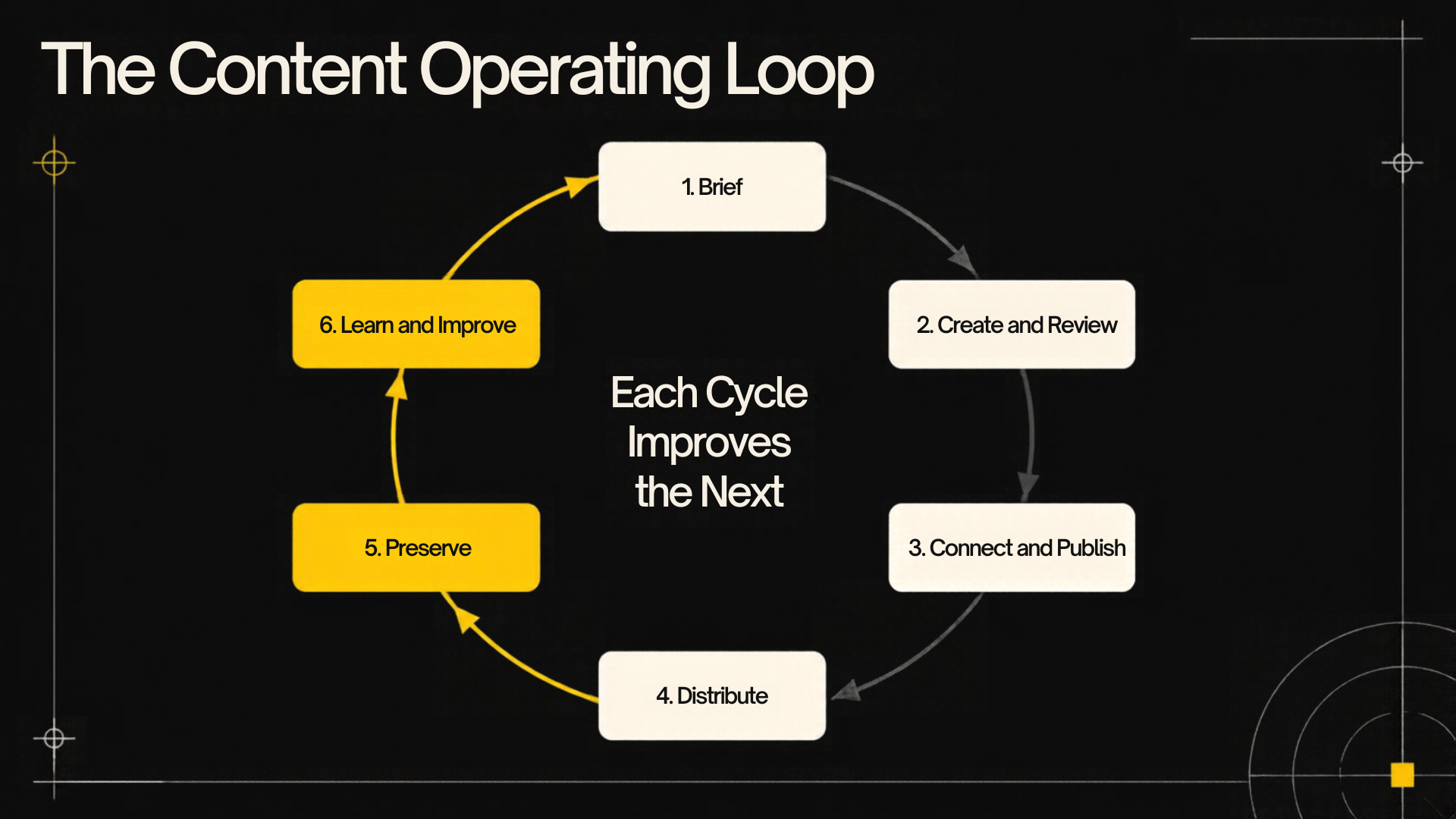
Once selected, each resource should move through a repeatable operating loop:
-
Brief: Define the reader's problem, intended outcome, available evidence, and relationship to existing content.
-
Create and review: Develop the resource, check accuracy, strengthen examples, and ensure it solves the intended problem.
-
Connect and publish: Add appropriate internal links, related resources, and next steps.
-
Distribute: Choose the channels and formats most likely to reach the intended audience.
-
Preserve: Save useful research, examples, and insights that didn't necessarily appear in the final piece.
-
Learn and improve: Review audience responses and performance, then decide what should change.
The last two activities are often what separate a publishing workflow from a learning system.
Where AI fits into the process
AI can help organize transcripts, cluster recurring questions, summarize source material, prepare briefs, identify related assets, compare drafts against editorial standards, and support content audits.
Its usefulness increases when it can work from accumulated business knowledge and a defined editorial process.
For example, an AI-assisted briefing workflow can draw on approved customer questions, previous research, existing resources, and documented positioning. The resulting brief has a better foundation than one generated from a topic title alone.
Human judgment still determines which problems matter, whether evidence is reliable, what conclusions are justified, and whether the finished content is genuinely useful.
https://mageaistudio.com/resources?type=Playbook&category=prompt-systems
Connect publishing, distribution, and conversion so content keeps working
An evergreen resource doesn't automatically distribute itself.
A useful article may need search optimization, internal links, founder-led distribution, newsletter promotion, relevant partnerships, or community participation before it reaches its intended audience.
The distribution plan should reflect how the audience discovers and evaluates information.
A search-led resource might depend on clear search intent, accessible page structure, and relationships with supporting articles. A founder insight may reach its audience through LinkedIn and later become evidence inside a more permanent website resource.
The channels can support one another without producing identical content.
Consider a substantial article about onboarding failures. It might lead to a LinkedIn post examining one overlooked failure mechanism, an audit checklist that helps readers diagnose their process, and a customer story demonstrating how a specific problem was resolved.
Each asset provides a different kind of value.
The objective is selective content multiplication, not turning every article into twenty variations of the same message.
Give readers a relevant next step
Content becomes commercially useful when it helps people progress naturally.
Someone reading an introductory guide may benefit from a more detailed explanation. Someone comparing solutions may need evidence, pricing information, or a practical assessment. Someone ready to act may want a consultation or product trial.
Not every resource needs an email gate or sales pitch.
However, when a useful next step exists, readers shouldn't have to reconstruct the journey themselves.
A connected path might look like this:
Search article → practical assessment → relevant recommendation → service or product evaluation.
Another could be:
Founder insight → evergreen resource → newsletter subscription → future educational content.
These pathways give existing content more opportunities to contribute beyond its initial publication.
Measure whether your content is gaining value or simply multiplying
A business can become more efficient at content production while its commercial results remain unchanged.
That's why publishing frequency, impressions, and total content volume are insufficient measures of compounding.
Look at four dimensions together.| What keeps happening | Likely system weakness | | --- | --- | | You repeatedly run out of ideas | Audience knowledge isn't being captured | | You publish unrelated articles | Content lacks a connected architecture | | You research the same problems repeatedly | Useful knowledge isn't preserved | | Strong content receives little attention | Distribution is underdeveloped | | Traffic grows without qualified inquiries | Reader intent and conversion paths aren't aligned | | Older resources steadily deteriorate | Maintenance is missing | | Reports never change future decisions | The learning loop is broken |
One particularly useful question is:
How much meaningful activity comes from content created before the current reporting period?
For a search-led business, examine whether older articles continue generating qualified discovery and supporting conversions. For a social-first consultant, examine whether accumulated relationships, recognizable expertise, and reusable resources are improving the quality of conversations.
The indicators differ because the mechanisms differ.
There is also no universal timeline for compounding. Search visibility can take months to develop and may fluctuate. Professional relationships can develop through repeated interactions. Internal knowledge reuse may improve production much sooner.
Make performance reviews produce decisions
A monthly or quarterly review should identify which assets deserve updating, which topics need deeper coverage, which distribution channels are producing useful responses, and which activities should stop.
An old article with declining performance may need updated evidence or a clearer answer. Two overlapping articles might be stronger as one consolidated resource. A well-performing guide might deserve a practical supporting asset.
These decisions are the output of the review. A dashboard that never changes what the team does has limited operational value.
Don't let content debt compound alongside content value
Every new resource introduces some potential maintenance responsibility.
Over time, a growing library can accumulate outdated examples, duplicate topics, broken links, conflicting recommendations, and abandoned tools.
More content can eventually make the website harder to navigate and the business harder to understand.
A mature content system therefore needs a policy for refreshing, consolidating, redirecting, or retiring resources.
The goal is to grow the usefulness of the library, rather than preserve every page simply because someone once published it.
Build the smallest content system you can sustain
A solo consultant and a B2B SaaS company don't need identical content operations.
The consultant may begin by collecting recurring client questions, publishing founder-led LinkedIn insights, developing selected ideas into evergreen website resources, and reviewing the quality of resulting conversations.
The SaaS company may prioritize connected search content, product use-case pages, comparisons, customer education, and conversion analysis.
Both can compound. Their primary assets and distribution mechanisms simply differ.
For a small team, I would begin with one meaningful content territory, one primary distribution approach, a simple knowledge repository, a repeatable editorial workflow, and one appropriate conversion path.
A shared document, organized folder, lightweight backlog, and basic analytics may be enough. One tool can perform several functions.
A manageable publishing rhythm, even two substantial resources per month, can work if the business consistently captures insights, connects assets, distributes its work, and improves what already exists.
Expand when the system reveals a clear reason to do so.
That might mean developing another topic territory, introducing a newsletter, building a free tool, adding supporting SEO pages, or creating reusable AI-assisted workflows.
New capabilities should solve demonstrated problems, rather than simply increase the number of things the team must maintain.
The MAGE AI Content Compounding System
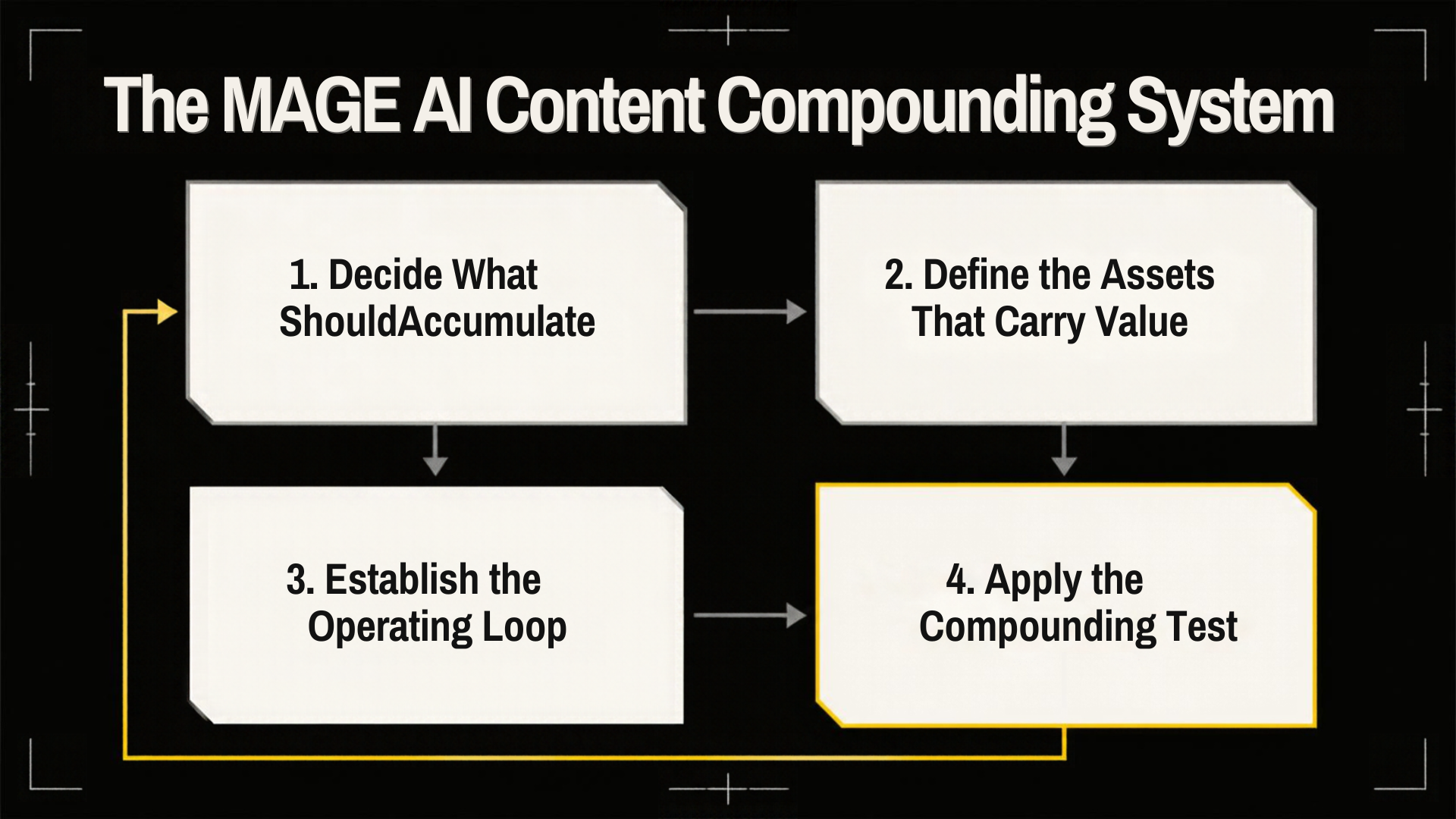
1. Decide what should accumulate
Identify the recurring audience problem, the content territory your business can credibly develop, and the primary outcome you want the system to improve.
That outcome might be qualified discovery, buyer trust, reusable expertise, audience relationships, or commercial conversion.
2. Define the assets that will carry that value
Choose the core resources worth maintaining, the supporting content that makes them useful, the knowledge worth preserving, the channels that will distribute them, and the next steps available to readers.
The assets should have meaningful relationships without requiring everything to connect to everything else.
3. Establish the operating loop
Capture knowledge, prioritize opportunities, create and review content, connect it to existing assets, distribute it, preserve reusable insights, and use performance evidence to improve the next cycle.
Assign responsibility for the activities that otherwise get forgotten, especially knowledge preservation, distribution, and maintenance.
4. Apply the compounding test
At the end of each content cycle, ask:
-
Did this work create something useful beyond its initial publication?
-
Did it strengthen an existing area of expertise or content coverage?
-
Did we preserve knowledge that could improve future work?
-
Did we create a meaningful connection to an audience or business outcome?
-
Did we learn anything that should influence our next decision?
Not every asset must satisfy every condition. But across several cycles, the answers should reveal whether the business is accumulating value or merely accumulating output.
If your business already publishes consistently but struggles to connect content, knowledge, distribution, and commercial outcomes, our content-led growth system can help you design the missing parts of the operation.
Frequently Asked Questions
What is the difference between a content calendar and a content system?
A content calendar organizes publication dates and topics. A content system connects strategy, knowledge, production, assets, distribution, and improvement so content work becomes repeatable and creates lasting value.
Can content compound without SEO?
Yes. Founder-led content, newsletters, and communities can compound through audience relationships, reputation, reusable expertise, and owned resources, even when individual social posts have short lifespans.
How long does it take for a content system to compound?
There is no fixed timeline. Knowledge reuse may improve workflows within weeks, while search visibility, authority, and qualified audience growth can require months or longer. The results depend on the market, content quality, distribution, competition, and execution.
How often should a small business publish?
Publish at a cadence that allows enough time for research, quality control, distribution, and improvement. Two strong resources per month may be more useful than daily content that the business cannot maintain or connect to its wider growth system.
Should every article be repurposed into social media content?
No. Repurpose selectively when an idea deserves another format or serves a different audience need. Repeating the same information across platforms without adding useful context rarely creates meaningful additional value.
What should I build first if I already publish regularly?
Audit where your existing operation loses value. If research is repeatedly discarded, improve knowledge capture. If strong articles receive little attention, improve distribution. If traffic doesn't progress toward useful actions, examine intent and conversion paths.
Can AI run an entire content system?
AI can support research organization, briefing, drafting, quality checks, repurposing, and performance analysis. Human oversight remains necessary for strategy, evidence verification, editorial judgment, and commercial decisions.
How do I know whether my content is genuinely compounding?
Look for evidence that previous work continues contributing value: older assets attracting relevant audiences, stronger topic coverage, growing trust or owned relationships, reusable knowledge, qualified inquiries, and improved operating efficiency. Compare those gains with maintenance costs and the effort required to sustain them.
When should I expand into another content channel?
Expand when the current system is functioning reliably and the additional channel has a defined purpose, a relevant audience, and sufficient operating capacity. Adding channels before establishing a working content loop often multiplies complexity faster than results.
The next content cycle should begin with more than a blank page and another deadline.
It should begin with better knowledge of your audience, useful assets already working, clearer editorial priorities, and evidence from what you've previously published.
That is the practical advantage of building a content system that compounds: future work becomes more informed and potentially more valuable because of everything the business has already built.