AI has made it easier to produce content, repurpose ideas, build landing pages, create lead magnets, and operate across more marketing channels. It has not created more hours in a founder's week or made every channel equally useful.
That makes choosing where to focus more important, not less.
The right organic growth channel is the one that best matches how your buyers discover and evaluate solutions, the growth constraint you need to solve now, the assets and capabilities you already possess, and the time and resources you can consistently invest.
That means the useful question is rarely just, “Should we do SEO or LinkedIn?” You first need to know what the next growth system needs to accomplish.
Start with the growth constraint, not the channel
A channel can be excellent and still be wrong for your business right now.
SEO can create valuable compounding acquisition, but that may not be the first priority for a founder who is still changing the offer every few weeks and needs rapid feedback from potential customers.
Founder-led LinkedIn can expose ideas to the market quickly and build visible expertise, but it becomes difficult when the company has no reliable way to extract the founder's thinking or sustain production.
A lead magnet can turn existing attention into identifiable prospects, but it will not repair a business that barely has any distribution.
A free tool can become a durable acquisition asset. Building one before you understand which problem buyers repeatedly care about can create an expensive product that nobody needs.
Start by diagnosing the constraint.
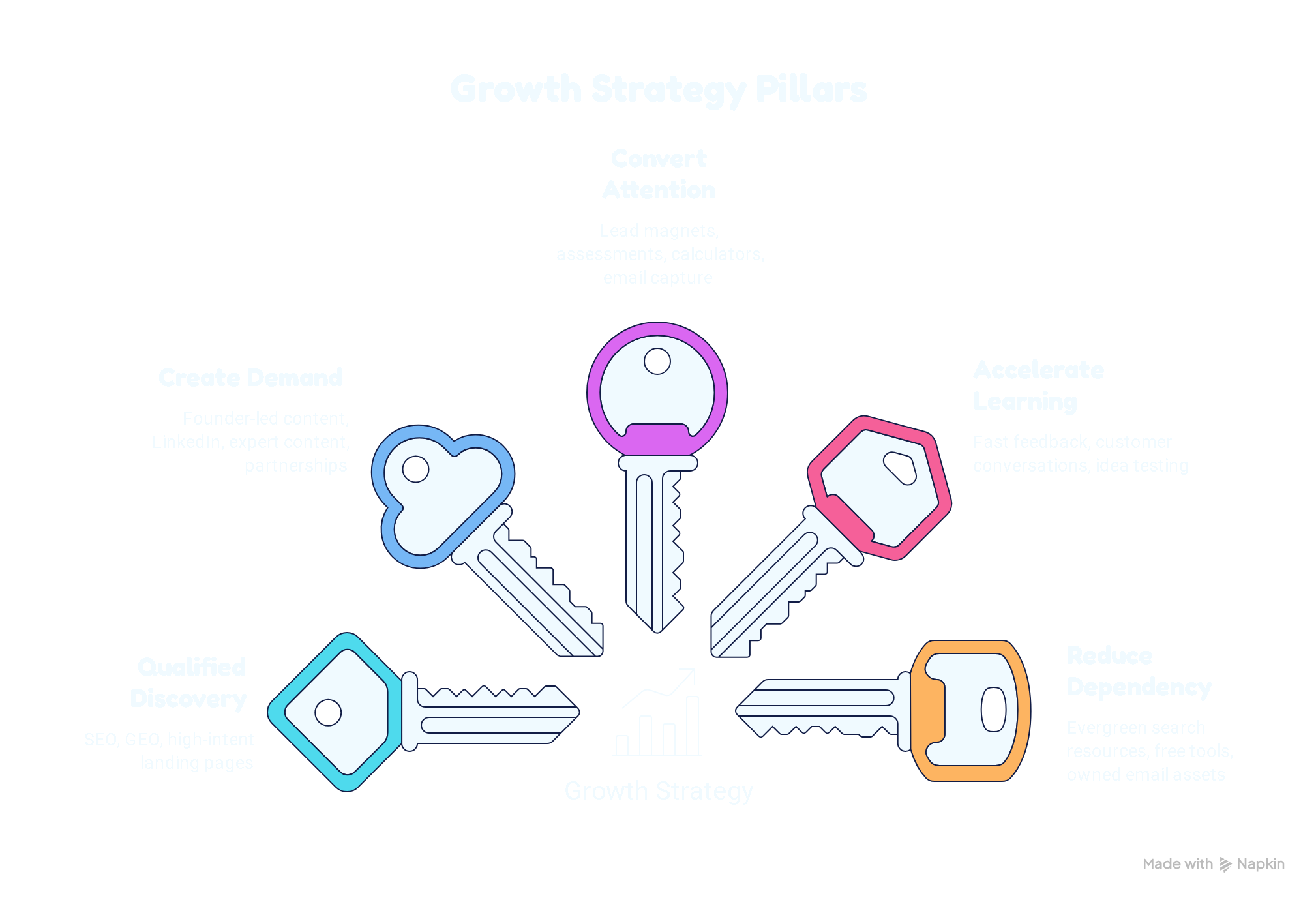
If you need more qualified discovery
You may already operate in a market where buyers actively search for the problem, service, category, comparison, or use case.
Your problem is being absent when that search happens.
SEO, GEO, high-intent landing pages, and carefully selected scaled-search opportunities deserve investigation because the acquisition problem is primarily one of discoverability.
If you need to create demand or authority
Sometimes buyers are reachable, but they are not actively searching for your exact solution.
Perhaps the category is unfamiliar. Perhaps trust matters heavily. Perhaps your expertise is one of the strongest reasons to choose the company.
Founder-led content, LinkedIn, expert content, partnerships, and other audience-led distribution mechanisms can become more valuable here.
If you already have attention but struggle to convert it
Traffic, followers, conversations, and reach are not automatically acquisition systems.
If people already pay attention but there is nowhere useful for that attention to go, the missing layer may be a lead magnet, assessment, calculator, template, email capture mechanism, or another conversion asset.
A lead magnet cannot repair a distribution problem. But when distribution already exists, it can give that attention somewhere productive to go.
If you still need market learning
An early-stage business with an evolving ICP, offer, or positioning often benefits from feedback speed.
A channel that puts the founder close to customer reactions can be more useful at this stage than one with theoretically better long-term economics.
You are not only acquiring customers. You are learning which problems attract attention, which language resonates, which objections keep appearing, and which parts of the offer people actually value.
If you need acquisition that becomes less founder-dependent
The constraint changes again when the founder already generates opportunities but wants assets that can continue working without their constant presence.
Evergreen search resources, landing-page ecosystems, useful tools, databases, owned email assets, and some partnership systems may deserve more weight.
Once you know what needs to improve, you can evaluate channels against the reality of the business rather than their popularity.
Seven variables should determine your channel choice
I would evaluate the options against seven variables.
1. Where and how buyers look for answers
Start with buyer behavior.
Do buyers already know what to search for? Do they discover solutions through experts they follow? Do peer recommendations carry unusual weight? Does the purchase begin with research, a referral, a conversation, or a specific operational problem?
This creates an important distinction between demand capture, demand creation, and relationship-driven discovery.
Search becomes particularly interesting when buyers can articulate what they need and actively look for it. Founder-led distribution can become more useful when expertise, education, or category creation has to precede demand. Partnerships and referrals can matter disproportionately where trust networks influence the shortlist.
Do not choose a channel merely because you enjoy using it. Look at how your buyers actually move.
2. How much trust the purchase requires
A low-risk purchase and a complex five-figure engagement do not have the same acquisition dynamics.
As transaction value, complexity, perceived risk, sales-cycle length, stakeholder count, and proof requirements increase, the growth system usually has to do more than generate visibility.
It may need to demonstrate expertise repeatedly, answer objections, establish proof, help internal champions justify the decision, and give buyers enough confidence to continue.
That is why raw reach can be a poor way to compare channels. The better question is whether the channel helps create the kind of trust the purchase requires.
3. What growth assets you already own
Businesses often plan growth as though they are starting from zero.
Usually, they are not.
You might already have search authority, an email list, a founder with a strong professional network, years of proprietary expertise, customer stories, internal data, partnerships, existing content, community access, or repeatable intellectual property.
I call the useful principle here asset adjacency.
A promising growth engine is often one that sits close to an advantage you already possess.
A consultant with a strong network and years of expertise may have a much shorter path into founder-led LinkedIn than into a large search program. A company already ranking for commercially relevant topics may have more to gain from improving its search ecosystem than starting an entirely new distribution engine.
Audit what you have before deciding what you need.
4. Whether you need fast feedback or stronger compounding
Feedback speed and compounding potential are different characteristics.
Founder-led social content can expose ideas to an audience quickly. You can see what triggers conversations, questions, objections, and interest.
SEO usually asks for more patience. The trade-off is that a useful search asset can continue attracting relevant discovery long after publication.
Neither characteristic is automatically better.
An early founder still figuring out the market may value fast learning more heavily. An established company with validated positioning and known search demand may rationally accept slower feedback in exchange for stronger compounding.
Think about channels across two dimensions:
Feedback speed: How quickly can this channel teach us something useful?
Compounding potential: How much value can today's work continue creating later?
Where a channel sits will vary by business and execution quality, so treat this as a decision aid rather than a universal scorecard.
5. What you can consistently operate
Budget is only one resource.
Organic growth can require founder time, subject-matter expertise, writing, research, technical implementation, design, development, distribution, editing, sales follow-up, measurement, and management.
The important test is not whether you can launch a channel.
It is whether you can operate it long enough to learn from it.
A business that can fund ten SEO pages but cannot maintain a useful content program does not necessarily have SEO capacity. A founder who can publish on LinkedIn for two weeks but cannot sustain idea extraction, writing, approval, and engagement does not yet have a reliable founder-content system.
6. How dependent the channel is on the founder
Founder dependency deserves more attention in channel planning.
Some growth engines benefit enormously from the founder's expertise, personality, relationships, or participation. Others can become increasingly institutionalized.
Ask what the channel requires from the founder.
Does the founder have to generate the ideas? Must they approve everything? Is their personal participation part of why the content works? Can their knowledge be systematically extracted? Can production eventually be delegated without losing the qualities that create trust?
High founder dependency is not automatically bad. It becomes a problem when the company selects a channel whose operating requirements conflict with the founder's actual availability.
7. What happens if the channel succeeds
This is one of the most overlooked questions in channel selection.
Businesses naturally ask whether they can make a channel work. They spend less time asking whether they can handle it working.
If SEO succeeds, who maintains an expanding content and landing-page estate?
If founder-led LinkedIn succeeds, can the company sustain idea extraction, publishing, engagement, and lead handling?
If a free tool attracts thousands of users, who maintains it?
If partnerships become an important acquisition source, who manages those relationships?
If a lead magnet generates significant demand, what nurtures and converts those leads?
The right growth channel is not merely one you can start. It is one whose success your business can absorb.
Compare channels by operating characteristics, not popularity
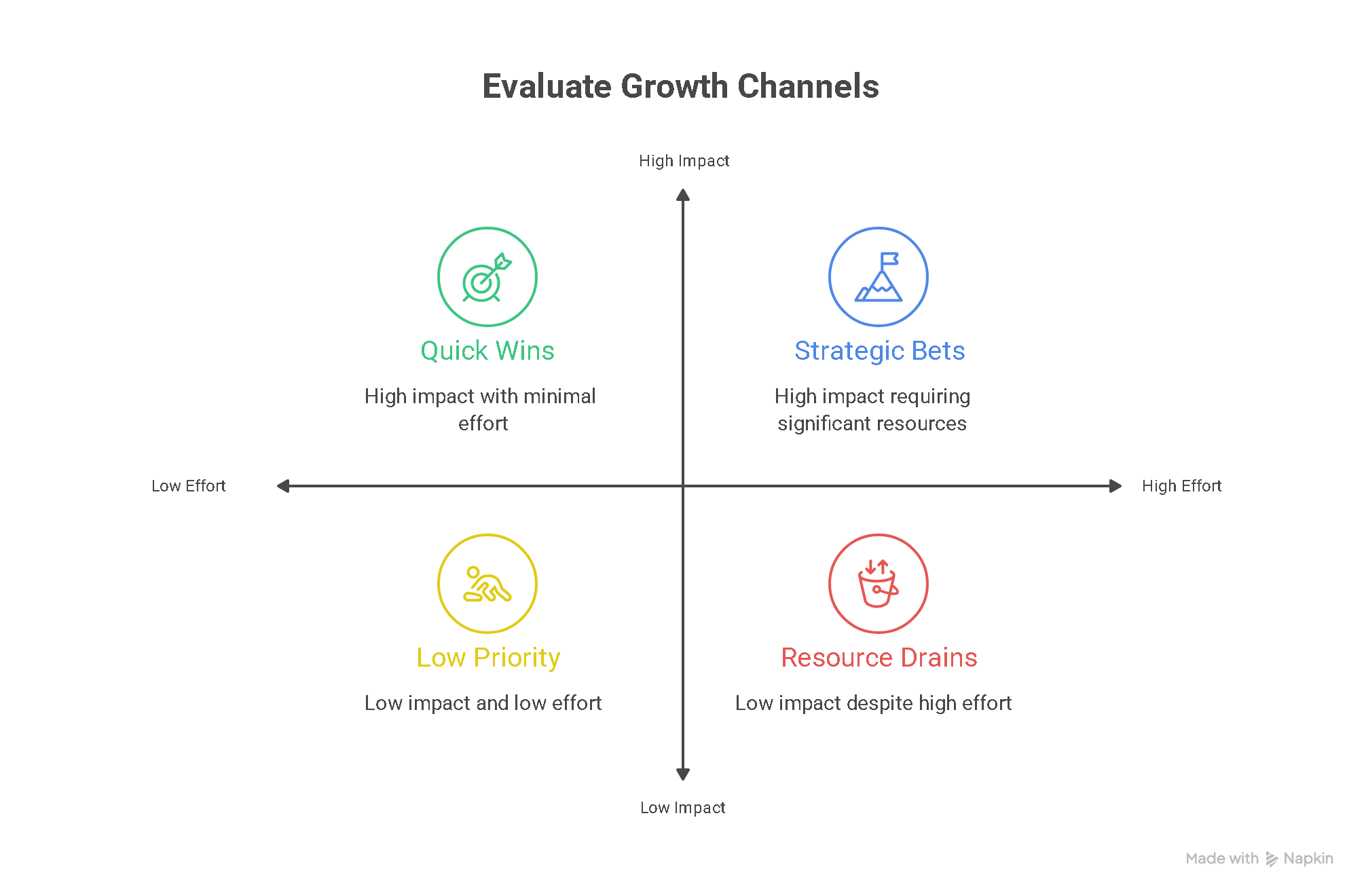
Once you understand the variables, channel comparison becomes much more useful.
[table]
These are directional tendencies, not universal scores. A highly authoritative site can see search results faster than a new domain. A strong founder with an established audience can make LinkedIn behave very differently from someone starting with no network.
The matrix helps narrow the decision. It should not make the decision for you.
Turn the diagnosis into a growth system
I would reduce the decision to six steps.
1. Name the constraint. Complete the sentence: “Our most important organic growth problem right now is ______.” That might be insufficient discovery, weak authority, poor conversion, excessive dependence on referrals, no owned audience, or not enough market feedback.
2. Identify where buyers can realistically be reached. Look at where they search, learn, follow experts, ask peers, evaluate providers, compare alternatives, and return for information.
3. Audit your unfair starting assets. Identify the authority, audience, expertise, data, relationships, rankings, content, customer proof, or intellectual property that could give one channel an easier starting position.
4. Apply the hard constraints. Time, budget, team capacity, founder availability, technical resources, feedback requirements, and operational capacity can eliminate attractive options that are unrealistic now.
5. Compare the remaining trade-offs. SEO may ask you to accept slower feedback for stronger compounding. Founder content may require more founder involvement in exchange for faster learning and visible expertise. A free tool may require greater build and maintenance complexity for the possibility of durable acquisition.
6. Choose a primary engine. Do not finish the exercise with a shopping list of tactics.
A useful output might look like this:
Primary acquisition engine: Founder-led LinkedIn
Supporting conversion asset: Diagnostic lead magnet
Owned follow-up: Email
Deferred: SEO until positioning and recurring demand patterns are clearer
Another business might arrive at:
Primary acquisition engine: SEO/GEO landing pages
Authority support: Founder expert commentary
Conversion asset: Assessment
Deferred: Free-tool development
This is the distinction between selecting channels and designing a growth system.
https://mageaistudio.com/founder-os#blueprint
Add channels when they have a clear job
Focusing does not mean your business must permanently use one channel.
Strong organic growth systems often contain several components. The difference is that each component has a defined role.
A founder-led authority system might work like:
LinkedIn → useful resource → email capture → nurture → sales conversation
A search-led system might be:
SEO/GEO pages → high-intent visitor → proof or decision resource → conversion → sales process
A tool-led system could become:
Free tool → discovery → useful output → captured intent → relevant service or product pathway
The mistake is treating every component as an independent growth initiative requiring its own strategy, production process, measurement system, and management attention from day one.
Diversification should follow validation, not precede it.
You can add a conversion layer when traffic exists but conversion is weak. Add another distribution channel when you have repeatable ideas and enough operating capacity. Build a compounding owned asset when a social or relationship-driven engine is already teaching you which problems repeatedly matter.
Expansion should be triggered by evidence rather than boredom.
Look for repeatable acquisition, understood audience response, stable production, measurable conversion, enough operating capacity, diminishing returns in the existing channel, or an obvious complementary opportunity.
That lets your growth system evolve without turning every new idea into another obligation.
Use this Founder Growth OS channel decision framework
Before committing the next six months to a channel, answer these questions.
Diagnose
Current constraint: What must improve next?
Buyer behavior: Where does discovery and evaluation naturally happen?
Existing assets: What advantages do you already possess?
Urgency: How quickly do you need useful feedback?
Resources: What can you realistically sustain?
Founder involvement: How much participation is actually available?
Operational capacity: What happens if the channel works?
Decide
For each serious channel candidate, ask:
-
Does it address the current constraint?
-
Does buyer behavior support it?
-
Can existing assets accelerate it?
-
Does its time horizon fit what we need?
-
Can we operate it consistently?
-
Can we tolerate its trade-offs?
-
Can we absorb its success?
Then design the system:
Primary growth engine: __________
Supporting distribution or conversion asset: __________
Owned asset: __________
Measurement signal: __________
Channels deliberately deferred: __________
Condition that would justify adding another channel: __________
That last question matters.
You are not saying no to every other channel. You are defining the conditions under which adding one becomes rational.
https://mageaistudio.com/founder-os
If you still cannot determine where SEO, GEO, founder-led content, LinkedIn, lead magnets, free tools, and other organic channels belong in your growth system, that uncertainty is itself useful information. It usually means the business needs a clearer diagnosis of its buyers, current constraint, assets, and operating capacity before it needs another marketing tactic.
Frequently Asked Questions
Which organic marketing channel should a business start with?
Start with the channel that best addresses your current growth constraint and matches how your buyers already discover or evaluate solutions. A business with strong searchable demand may prioritize SEO, while one that needs rapid market learning and visible expertise may get more immediate value from founder-led distribution.
Should a startup focus on SEO or LinkedIn first?
It depends on buyer behavior, offer maturity, feedback needs, and founder capacity. LinkedIn can be useful when rapid feedback, expertise, and relationship-building matter. SEO becomes especially attractive when buyers already search for the problem and the business is ready to invest in assets that may take longer to compound.
How many organic growth channels should a startup use?
There is no useful universal number. A startup usually benefits from identifying one primary acquisition engine and then adding supporting assets that perform specific jobs, such as conversion or follow-up. Additional distribution channels make more sense once the first system is understood and repeatable.
How long should you test an organic growth channel before deciding it does not work?
Use the channel's natural feedback cycle rather than applying one universal deadline. Founder-led social content can produce learning signals relatively quickly, while search-led acquisition often needs a longer evaluation horizon. Define the signals you expect before launching, then judge the channel against those signals and the quality of execution.
What is the best organic growth channel for a small budget?
A small budget does not automatically point to one channel because time, expertise, audience access, and existing assets also have economic value. The strongest option is often the channel closest to an advantage you already possess, such as founder expertise, an existing network, search authority, customer relationships, proprietary data, or reusable content.
When should a business avoid investing heavily in SEO?
Heavy SEO investment may be premature when the offer changes constantly, the ICP remains unclear, buyers rarely search for the problem, the website cannot support the required experience, or the company urgently needs fast market feedback. That does not make SEO ineffective. It means another growth constraint may deserve attention first.
Can lead magnets become a primary acquisition channel?
Usually, a lead magnet is better understood as a conversion asset than a standalone acquisition engine. It becomes useful when another mechanism already creates attention or discovery. Without distribution, even an excellent lead magnet can remain largely invisible.
What is the biggest risk of using several organic channels at once?
The main risk is fragmented learning and execution. When several channels launch simultaneously, a small team may struggle to determine what is actually working, maintain quality, or give any channel enough time to mature. Multiple components are useful when each has a defined role inside one growth system.
How do you know when it is time to add another growth channel?
Look for evidence that the existing engine is becoming repeatable: stable production, understood audience response, measurable conversion, sufficient operating capacity, or a clear complementary opportunity. Expansion should solve a new constraint or strengthen the existing system, rather than simply satisfy the urge to be present somewhere else.