If ChatGPT mentions your competitors but not your brand, do not assume they have discovered a secret way to “rank in ChatGPT.”
There are several possible explanations. ChatGPT search may not be able to access the pages you want it to use. Your company may be harder to understand in relation to the question being asked. You may not have useful content for that particular decision. Your competitor may provide stronger evidence or a more useful answer. Or information elsewhere on the web may make the competitor easier to identify and place in context.
The important distinction is this:
Being absent from one ChatGPT answer is an observation. Repeated absence across questions your buyers actually ask is a visibility problem worth diagnosing.
And diagnosis should come before publishing more content.
First, Determine What Kind of Visibility Gap You Have
A brand mention, a citation, and a recommendation are different things.
ChatGPT can answer from model knowledge, use web search, cite sources, and surface links. When web search is involved, OpenAI says ChatGPT may rewrite the user's question into targeted searches and use search providers to retrieve relevant information. OpenAI also warns that search results and citations can sometimes be incomplete, outdated, or incorrect.
So asking ChatGPT one question, taking a screenshot, and concluding that a competitor has “better GEO” tells you very little.
A better audit looks for a pattern across questions such as:
-
Who provides this type of service?
-
What are the best options for this problem?
-
What are the alternatives to X?
-
Which solution fits a company like ours?
-
How much does this approach cost?
-
What are the risks?
-
How should we compare providers?
-
What should we do before implementing it?
If competitors repeatedly appear across commercially relevant questions and your brand does not, then you have something meaningful to investigate.
Check Whether ChatGPT Search Can Access Your Site
Start with the boring possibility before rebuilding your content strategy.
OpenAI says any public website can appear in ChatGPT search. For content to be discoverable and included in summaries and snippets, site owners should make sure they are not blocking OAI-SearchBot. OpenAI also recommends checking whether the website host or content delivery network permits traffic from its published searchbot IP addresses.
That makes technical accessibility a prerequisite, not a guarantee.
Check whether the pages you expect ChatGPT search to use are public and crawlable, and whether robots.txt, firewall rules, CDN settings, bot protection, authentication, or other controls are blocking access.
If your competitor's relevant pages are accessible and yours are not, there is little value in debating content quality until that problem is fixed.
Is Your Brand Clear Enough to Understand?
Imagine someone encounters three pages on your website.
Your homepage describes you as an AI growth partner.
A service page describes you as a digital marketing agency.
Another page calls the company an AI transformation studio.
Those phrases may all make sense internally. Together, however, they can leave an unclear picture of what category the company belongs to, what it actually sells, who it serves, and which problems it should be associated with.
This is where entity clarity becomes a useful diagnostic concept.
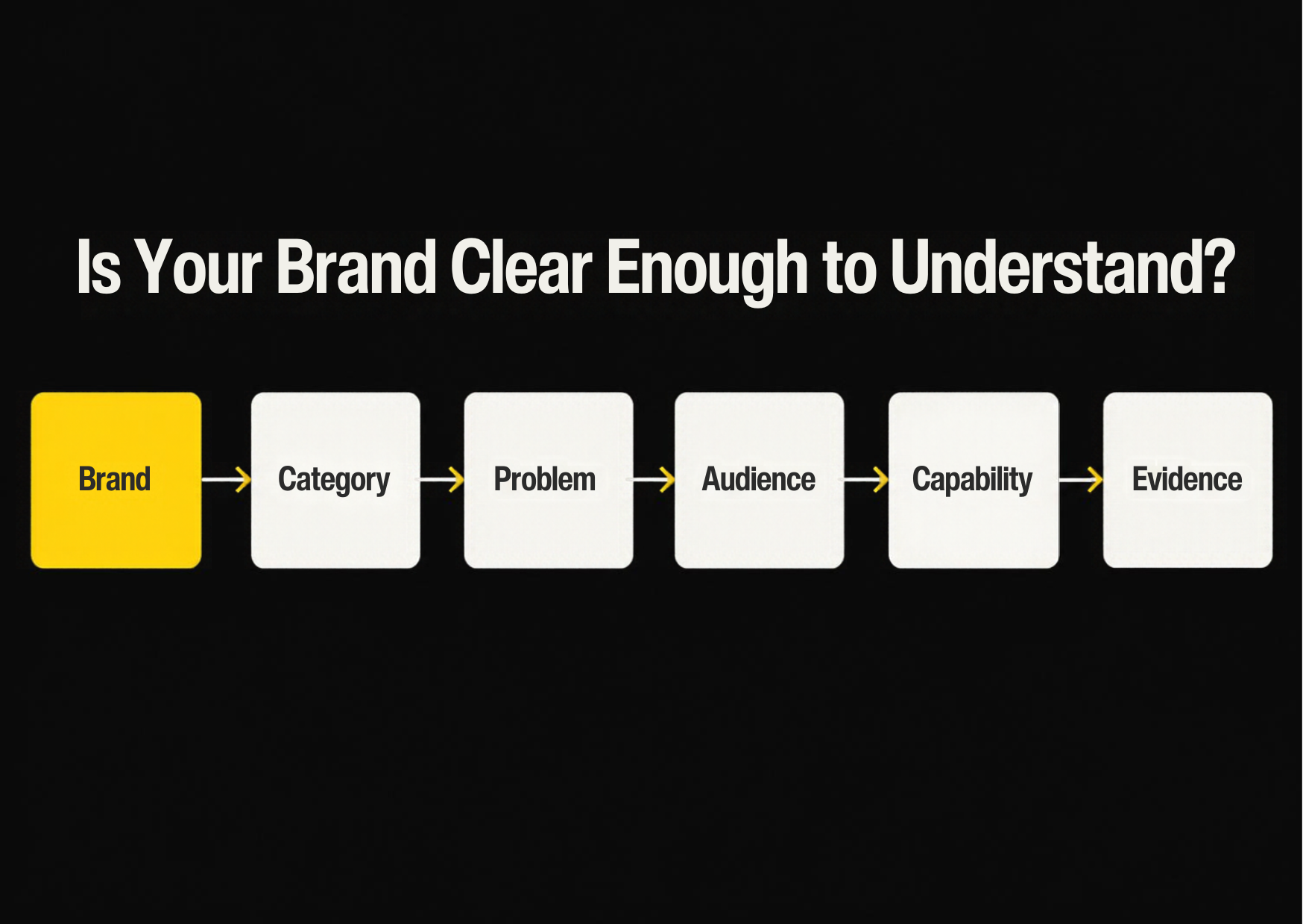
A reader should be able to form a coherent relationship between:
Brand → Category → Problem → Audience → Capability → Evidence
That does not mean repeating exactly the same phrase on every page. It means using terminology and explanations consistently enough that the relationships are understandable.
This is a diagnostic principle, not a published OpenAI ranking factor. OpenAI has not published a formula saying that following this structure causes a brand to be recommended.
Do You Actually Cover the Questions Buyers Are Asking?
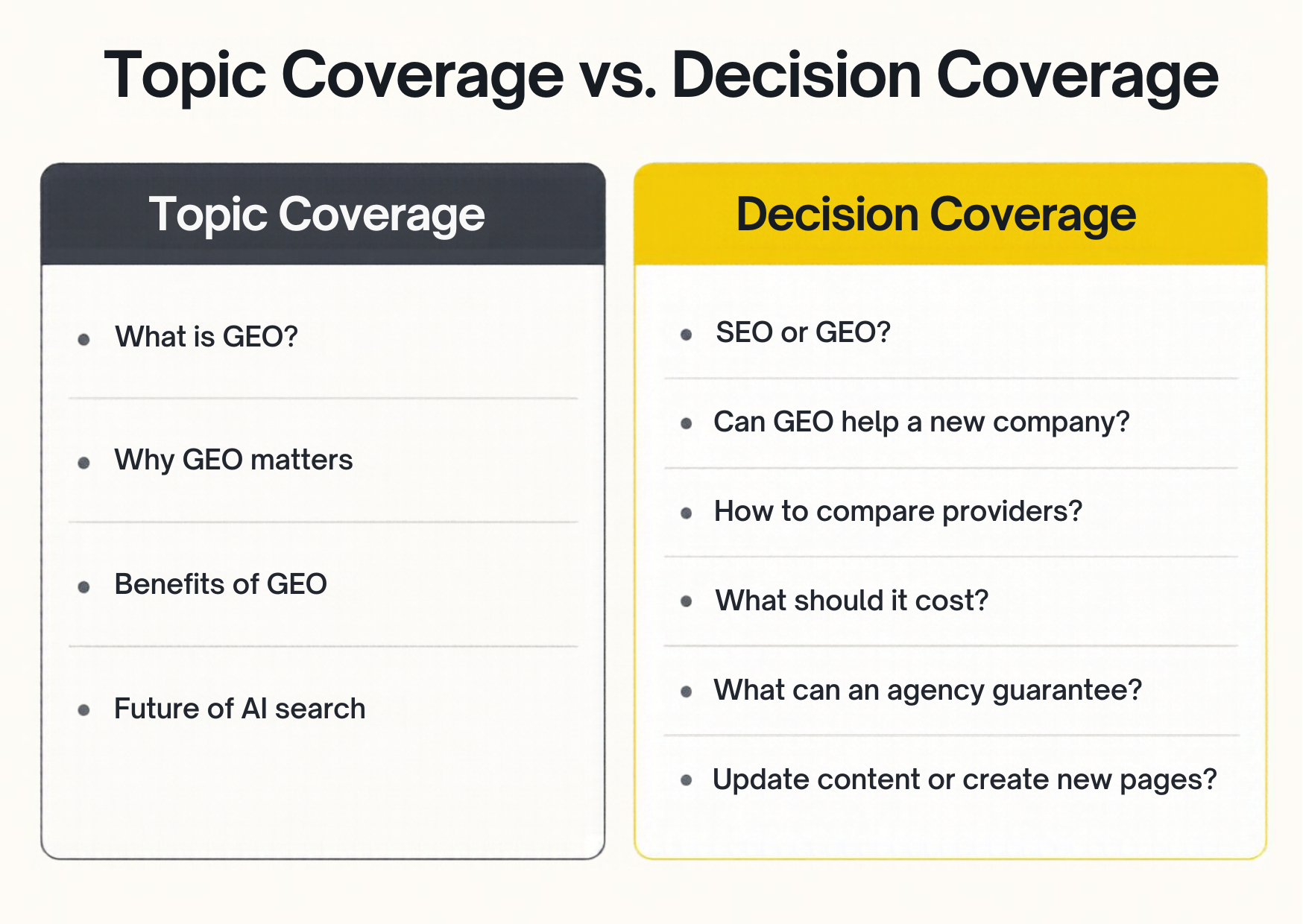
Imagine a GEO agency with 40 articles about AI search.
The articles explain:
“What is GEO?”
“Why GEO matters.”
“Benefits of GEO.”
“Future of AI search.”
But buyers are asking:
“Should we prioritize SEO or GEO?”
“Can GEO help a new company with almost no authority?”
“How do I compare GEO providers?”
“What should this cost?”
“What can a GEO agency realistically guarantee?”
“Should we update existing content or create new pages?”
That company has topic coverage, but weak decision coverage.
This distinction matters because people do not only ask AI systems for definitions. They ask them to diagnose problems, compare alternatives, explain risks, identify fit, recommend next actions, and help make decisions.
The question is therefore not simply:
Do we have content about this topic?
It is:
Do we have useful answers for the question space surrounding the buying decision?
Is Your Page Useful Enough to Support the Answer?
Suppose both you and your competitor have a page about the same service.
Your page says:
We provide innovative GEO solutions that improve AI visibility and help forward-thinking businesses succeed in the future of search.
Your competitor explains:
-
what the service actually does
-
who it is appropriate for
-
when it is unlikely to help
-
how it differs from traditional SEO
-
what implementation requires
-
what usually goes wrong
-
what evidence should be reviewed
-
which alternatives exist
-
what someone should evaluate before buying
Which page gives an answer system more usable material for a buyer trying to make a decision?
OpenAI does not publish a checklist saying that those specific elements cause inclusion. What it does say is that ChatGPT search ranks results using multiple factors intended to surface relevant and reliable information, and that placement is not guaranteed.
So do not reduce the problem to keyword placement.
A more useful GEO question is:
Does this page contain information worth retrieving for the question being asked?
[table]
A page can be perfectly understandable to Google and still offer little that improves an AI-generated answer.
Does Your Competitor Have Stronger Evidence?
Explanation and credibility are different problems.
You may explain your service clearly but support most claims with assertion.
A competitor may have customer cases, original data, documented processes, expert commentary, benchmarks, primary sources, or concrete examples.
That does not prove ChatGPT will prefer the competitor. OpenAI has not published an evidence-weight formula for brand mentions.
But from an editorial perspective, it gives the competitor more support for claims that would otherwise have to be taken on trust.
The same principle applies to your own content.
If you say a method reduces acquisition cost, improves conversion, or increases AI visibility, ask:
What supports that statement?
If the answer is nothing, either find appropriate evidence, qualify the claim, or remove it.
Look Beyond Your Own Website

OpenAI says ChatGPT search sometimes works with external search providers and may send them rewritten versions of a user's query to retrieve relevant information.
That makes it reasonable to investigate how your brand appears outside your own domain.
Look at relevant industry publications, partner websites, interviews, reviews, directories, research, customer stories, podcasts, and other credible third-party sources.
Are they describing your company consistently?
Do they connect you with the problems and category you want to own?
Are your competitors repeatedly present in places where your brand is absent?
Treat this as diagnostic evidence, not a magic backlink formula. There is no public OpenAI rule saying that a specific quantity of third-party mentions produces a ChatGPT recommendation.
Audit a Question Set, Not One Prompt
The goal of an AI visibility audit should be to identify patterns.
A useful question set can move through:
Problem → Solution → Comparison → Fit → Evidence → Risk → Action
For each question, record which brands appear, how they are described, whether sources are cited, which sources appear, and whether the answer accurately represents each company.
Then look across the set.
You might discover that your brand appears for broad category questions but disappears in comparisons.
Or that ChatGPT knows what your company does but associates it with the wrong use case.
Or that you appear when the company name is explicitly included but rarely in discovery questions.
Those are different problems. They should not receive the same fix.
Diagnose the Failure Point Before Choosing the Fix
The practical sequence is:
Accessibility → Entity clarity → Question coverage → Source usefulness → Evidence → External context → Measurement
If accessibility is broken, fix access.
If your company is difficult to understand, improve entity and offer clarity.
If the relevant question space is missing, build the missing content.
If existing pages are generic, deepen the answer instead of simply creating more URLs.
If material claims lack support, strengthen the evidence.
If the wider web consistently understands competitors better than your brand, investigate the authority and information ecosystem around the category.
And if your entire conclusion came from one prompt, improve the measurement before changing anything else.
Do not respond to every AI-visibility problem by publishing another 50 articles.
What Not to Do When a Competitor Appears and You Do Not
Do not clone the competitor's articles.
Do not assume structured data alone will solve an unclear positioning or content problem.
Do not manufacture third-party mentions.
Do not rewrite your entire website because of one ChatGPT response.
And be cautious with anyone promising guaranteed ChatGPT placement. OpenAI explicitly says placement in ChatGPT search is not guaranteed.
Start With the Information Environment
If ChatGPT repeatedly mentions competitors but not your brand, the useful question is not:
“How do we make ChatGPT mention us?”
Ask:
“What information is available for ChatGPT to discover, understand, verify, and use when someone asks a question our company should legitimately help answer?”
Then diagnose the answer systematically.
Your goal is not to manipulate one output.
It is to make your company easier to access, easier to understand, better represented across the questions buyers ask, and better supported when it makes a claim.
ChatGPT mentions are an outcome you can monitor.
The stronger asset is the information environment that makes an accurate mention useful in the first place.